
Challenges
The line needed to process different autoinjectors and multiple tray types while ensuring high process stability despite its design as a small-batch and laboratory solution. In addition, both rotary and non-rotary labels had to be applied, including booklet labels. For study batches, placebo and active-ingredient pens had to be indistinguishable after labeling. A product-specific serialization concept needed to be implemented with full flexibility. Format changes had to be fast, reproducible, and clearly guided.
Our Solution
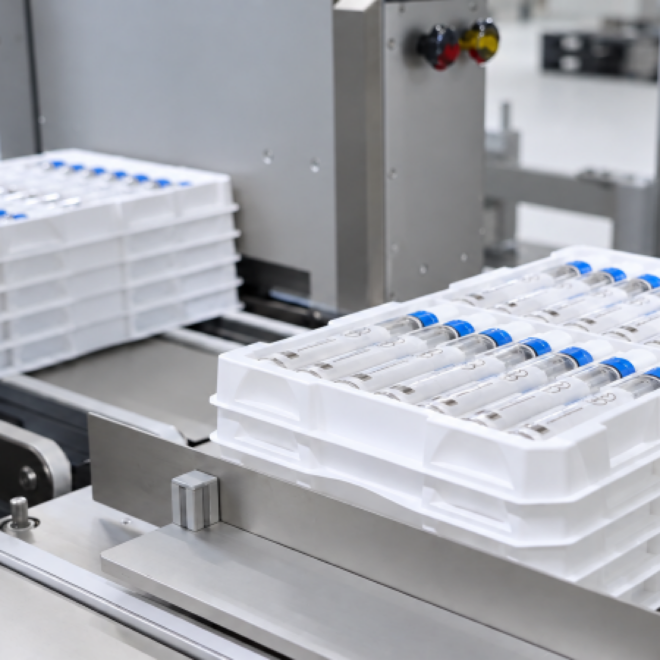
We developed a variable tray magazine with robot-based infeed, enabling reliable singulation, alignment, and presentation of different autoinjector variants. The labeling station was designed to handle both rotary and non-rotary labels with high stability, including booklet labels. Clearly defined format parts and a structured changeover concept allow fast and reproducible setup adjustments. All format parameters are managed and monitored within the control system, which also enables integration of a customer-specific serialization concept. This allows study batches to be labeled so that placebo and active-ingredient products remain indistinguishable.
Special Features
The Labeler One combines robot-assisted infeed with broad labeling functionality, making it ideally suited for laboratory environments, small-batch production, and early product phases. Its modular design enables fast changeovers and provides a scalable foundation for later expansions or the transition to higher performance classes such as the Labeler 50 and Labeler 150.
Processes
-

Labeling
-
Tray Handling

Images & Media
